Concept · Applied Maths
The story of the lily pond: exponential growth, compounding and doubling
Why things that double are so hard to feel, what the rule of 72 tells you, and how growth and decay shape money, data, epidemics and technology.
Beginner7 min read

Key takeaways
- Exponential growth means multiplying by the same factor each step, so the increases themselves keep growing.
- Doubling is deceptive: a pond half covered is one day from being full.
- The rule of 72 gives a quick estimate of doubling time: divide 72 by the percentage growth rate.
- Exponential decay, such as half-life, is the same idea running backwards.
A fisherman, Karma, owns a small pond at the edge of his village. One spring, a single water lily appears on it. It is pretty, so he leaves it. A neighbour warns him: “Lilies double in number every day. If they cover the pond in thirty days, the fish will suffocate.” Karma shrugs. One lily is nothing.
For a long time, he is right. On day 10 the lilies fill a tiny corner. On day 20, they cover less than a thousandth of the pond. Karma barely notices. Then he asks himself a question that makes his stomach drop: on which day is the pond half covered?
The day before the end
The answer is day 29. If the lilies double every day, and the pond is completely full on day 30, then it was half full on day 29. On day 28, it was a quarter full. For almost the entire month, the pond looked nearly empty. The disaster arrived in the last few days, and by the time it became obvious, there was almost no time left.
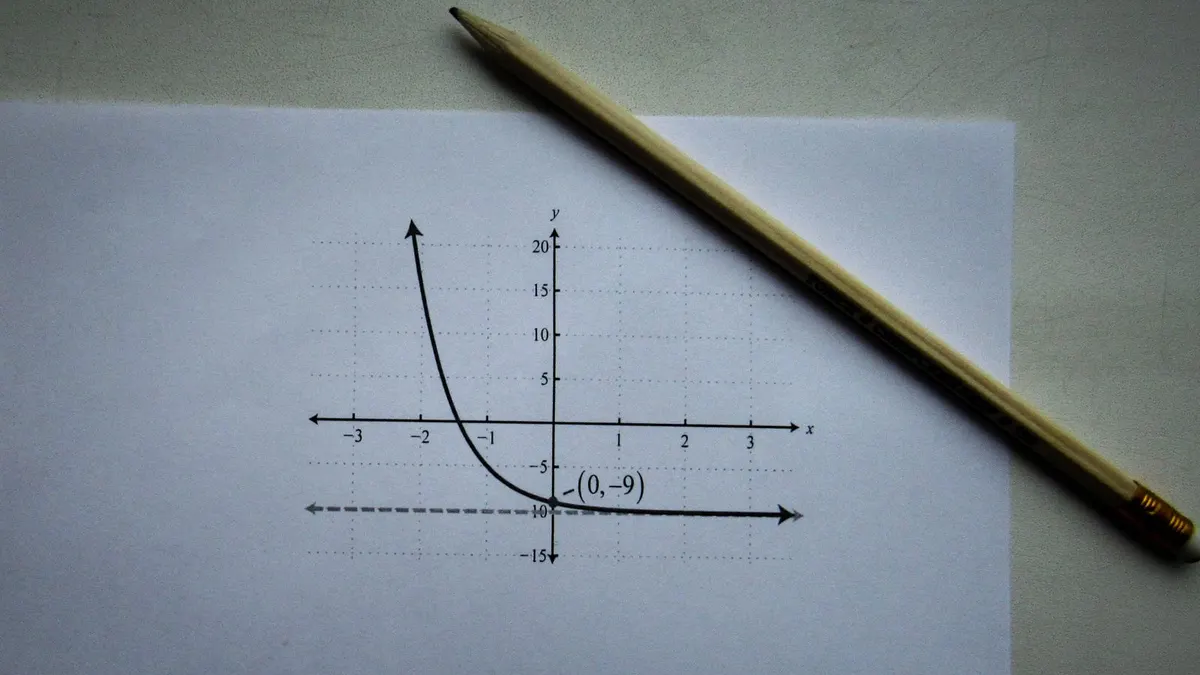
This is the nature of exponential growth. It is quiet for a long time, and then it is suddenly overwhelming. It is hard to feel, because our intuition is built for steady, additive change: one more step each time. Exponential change multiplies instead. Each increase is bigger than the last.
A counting experiment
Karma does the numbers on a piece of paper. A single lily on day 0 becomes 2 on day 1, 4 on day 2, 8 on day 3 and 16 on day 4. After 10 days, he has 1,024 lilies. After 20 days, more than a million. After 30 days, more than a billion. Doubling thirty times multiplies the start by more than a billion, a number that no one can feel directly.
Compare this to adding one lily each day. After thirty days, there would be 31. Growth by addition and growth by multiplication look the same on day 3 and absurdly different on day 30.
Compounding: growth on growth
Karma’s sister Dolma saves a little money in a village cooperative that pays 7 percent a year. She puts in 10,000. After one year she has 10,700. In the second year, the 7 percent is calculated on 10,700, not on the original 10,000, so she earns 749. This is compound interest: interest that earns interest.
- After 10 years at 7 percent a year, the 10,000 becomes about 19,700, almost double.
- After 30 years, it becomes about 76,100, more than seven times the start.
- Without compounding, simple interest of 700 a year would give only 31,000 after 30 years.
Loans compound in the same way, which is why a small debt at a high rate can balloon. The same arithmetic that helps savings grow makes debts harder to escape.
The rule of 72
Dolma learns a handy shortcut. To estimate how long money takes to double, divide 72 by the annual percentage rate. At 6 percent, it takes about 12 years. At 9 percent, about 8 years. At 2 percent, about 36 years. The shortcut works for anything that grows at a steady percentage, whether money, a population or a company’s sales.
- A town growing at 3 percent a year doubles in about 24 years.
- A user base growing at 10 percent a month doubles in about 7 months.
- A cost rising at 8 percent a year doubles in about 9 years.
Decay: growth in reverse
The same pattern runs backwards. Karma buys a medicine for his fish that breaks down in water. Half of it disappears every 2 days. This period is called its half-life. Start with 100 units. After 2 days, there are 50. After 4 days, 25. After 6 days, 12.5. It never quite reaches zero, but it becomes small very quickly.
Half-life describes radioactive materials, drugs in the body, the strength of a signal fading and the loss of value in some assets. It is exponential decay, and it follows the same logic, with a factor smaller than one.
Why growth rarely stays exponential
In real life, the lilies cannot keep doubling forever. They run out of pond. Nutrients, space and light become limits. A graph that starts as an exponential curve eventually bends into an S-shape, called a logistic curve, as growth slows and levels off. Epidemics, adoption of new technologies and populations of animals follow this pattern. The early part looks exponential, and the later part meets limits.
Knowing this stops you from making two common mistakes: assuming that fast growth will go on forever, and assuming that slow early growth means that nothing will happen.
Where this shows up in AI, maps and 3D
- Data growth: the amount of imagery, sensor data and text we produce grows rapidly, which is why storage and processing planning needs a doubling mindset.
- Model size and computing: the effort used to train large AI models has grown by large factors in short periods, which drives energy and cost questions.
- Epidemics and spreading processes: mapped growth of cases or wildfires depends on the factor by which each step multiplies.
- Levels of detail in 3D: each doubling of resolution in a grid multiplies the number of cells by four in two dimensions, and eight in three. That is why high-resolution 3D grows heavy so fast.
- Image pyramids and map tiles: each zoom level on a web map has four times as many tiles as the one before.
- Learning curves: a model’s error often falls quickly at first and then slowly, a form of decay.
The formulas behind the story
Karma’s pond, Dolma’s savings and the fading medicine are all one formula wearing different clothes.
N(t) = N₀ × 2ᵗ (doubling every step)
- N₀: the starting amount, here 1 lily
- t: the number of doublings, here days
- 2ᵗ: the multiplier after t doublings
In the story: after 30 days, 2³⁰ = 1,073,741,824 lilies. After 29 days it is half of that, which is why the pond is half full a day before it is full.
A = P × (1 + r)ᵗ
- P: the amount you start with (principal), 10,000
- r: the growth rate per period as a decimal, 0.07
- t: the number of periods, years here
- A: the amount after t periods
In the story: after 10 years, 10,000 × 1.07¹⁰ ≈ 19,672. After 30 years, 10,000 × 1.07³⁰ ≈ 76,123. Simple interest would be 10,000 + 700 × 30 = 31,000.
doubling time ≈ 72 ÷ r% (exactly: t = ln 2 ÷ ln(1 + r))
- r%: the growth rate as a percentage, such as 6
- ln: the natural logarithm, the exact inverse of exponential growth
In the story: at 6% the rule gives 72 ÷ 6 = 12 years. The exact formula gives 0.693 ÷ 0.0583 ≈ 11.9 years.
N(t) = N₀ × (½)^(t ÷ T) (half-life T)
- T: the half-life, the time for the amount to halve
- t ÷ T: how many half-lives have passed
In the story: the medicine has T = 2 days. After 6 days, t ÷ T = 3 halvings, so 100 × (½)³ = 12.5 units.
Try it yourself
- 01Take a sheet of paper and fold it in half. Fold again. How many folds can you do? How thick would it be after 42 folds, if you could?
- 02Use the rule of 72 to estimate how long it takes your savings, or a price, to double at a rate you know.
- 03Open a web map and zoom in one level. Count how the number of tiles changes.
Frequently asked questions
- Is exponential the same as fast?
- No. Exponential means multiplied by a constant factor each step. It can start slowly. What makes it special is that it eventually outruns any steady, additive growth.
- How accurate is the rule of 72?
- It is a good approximation for rates between about 2 and 15 percent. For an exact answer, use a calculator or logarithms.
- What is a logarithm?
- It is the opposite of an exponent. It answers the question, “how many times do I multiply to reach this number?”. Logarithms turn multiplication into addition, which makes huge ranges easy to plot.
- Why do charts of growth often use a log scale?
- Because on a log scale, steady percentage growth is a straight line, so it is easy to see whether growth is speeding up or slowing down.
Karma’s pond was saved, because on day 27 he began pulling lilies out. The lesson is one that applies far beyond ponds: when something doubles, the time to act is long before it looks serious. Learn to feel exponential change, and you can see problems, and opportunities, while they are still small.
Join the conversation
Reactions & comments
Comments are opening soon.
In the meantime, tell us what you think by email at info.istem.lab@gmail.com.